




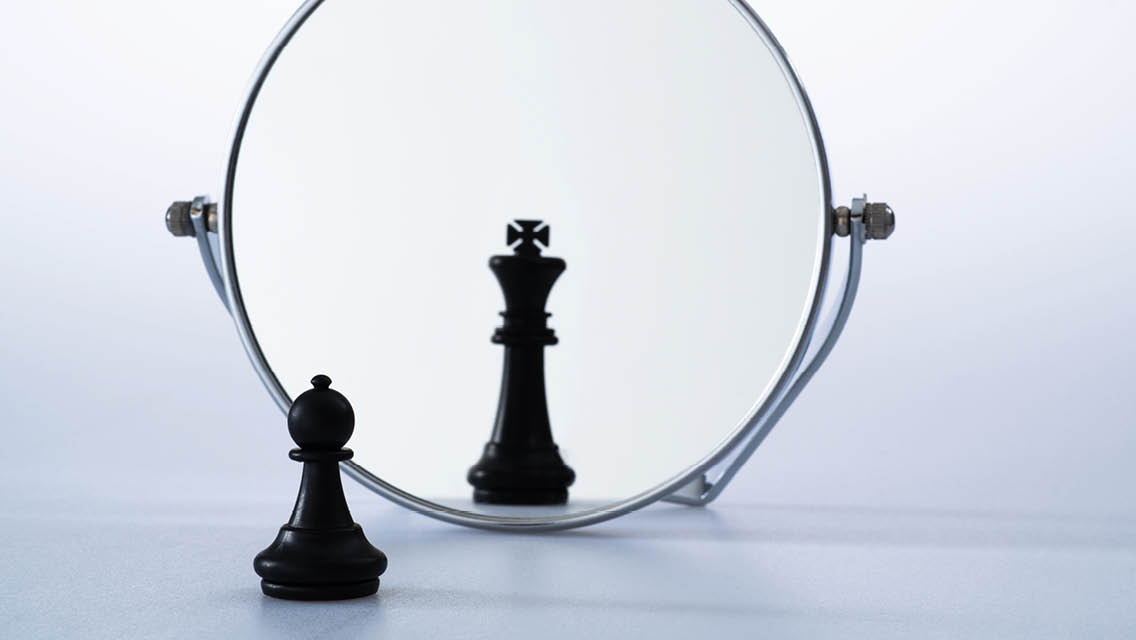
“Mirror, mirror on the wall: Who’s the fairest of them all?”
The Evil Queen in the fairy tale “Snow White” is a classic narcissist, so consumed by envy that she attempts to take her own stepdaughter’s life.
Narcissists believe they’re the fairest (or most successful, intelligent, or powerful) one of all, and they’re not afraid to flaunt it.
Grandiosity — an inflated sense of one’s own greatness — is a hallmark of narcissism. Narcissists often exaggerate their accomplishments, expecting recognition and admiration even when their achievements aren’t necessarily all that impressive. To a narcissist, people who don’t recognize how special the narcissist is must not be special enough to understand them.
Narcissists tend to look down on those they perceive as “lesser than” — but are even more threatened by those who outrank them. Like the Evil Queen, they become consumed by envy and can grow irritated, vengeful, or downright enraged when they’re not at the top of the ladder.
Unsurprisingly, narcissists are not easy people to be around. A preoccupation with power and prestige coupled with an absence of empathy compels many narcissists to manipulate others for their own purposes. They don’t take responsibility for their actions and are prone to deflecting, blaming, or lashing out at those who question them. Entitlement rules the day.
You might not notice these qualities when you first meet a narcissist: They know how to feign agreeableness when it serves them, and many are downright charming. Their confidence can be attractive, and their drive to succeed no matter the cost can propel them to positions of real power: A 2021 Stanford University study found that 18 percent of corporate CEOs are narcissists — well above the average population prevalence.
Still, there are fewer narcissists than the recent preoccupation with them would suggest. True clinical narcissists represent at most about 6 percent of the population, according to the Diagnostic and Statistical Manual of Mental Disorders (DSM-5).
“We have to be careful not to underestimate or overestimate the seriousness of a disorder or the prevalence of a disorder like narcissism,” writes Peter Salerno, PsyD, in his book The Nature and Nurture of Narcissism. “The term ‘narcissism’ was never intended to be used by the general public the way it has been used in recent years.”
Identifying someone you’re dealing with as a true narcissist means not only recognizing the characteristics of narcissism but also discerning between narcissistic tendencies and a narcissistic personality disorder. That’s not as easy as it may seem. And coping with these traits when they appear in a loved one, friend, or coworker can be even more daunting.
What Makes a Narcissist?
There is strong evidence of a genetic component to narcissism, Salerno notes. And there’s even stronger evidence of distinct neurological features: Neuroimaging studies show that narcissists have less gray matter in regions of the brain associated with empathy and self-awareness, as well as irregularities in areas associated with emotion regulation, social cognition, and impulse control, he writes.
Does that mean people are born narcissistic? Not necessarily.
A child raised by one or more narcissistic parents is at higher risk of both inheriting a genetic predisposition and being conditioned to value status and minimize the needs of others, making it hard to distinguish between nature and nurture. And because we can’t identify narcissists at birth, there’s no way to know whether those brain differences are organic or developed over time.
Moreover, personality types aren’t like blood types. They are subjective, multifaceted, and exist on a spectrum.
This is especially true with narcissistic-like tendencies. Many people can be arrogant at times, and most of us like to feel admired — but imagine if everyone who posted a filtered selfie was deemed clinically narcissistic.
What’s more, it can be difficult to tease out external factors that sometimes underlie narcissistic behaviors.
Childhood trauma, substance abuse, head injuries, and even developmental stages like adolescence can engender a tendency toward thoughtlessness, aggression, or insensitivity. Some social psychologists have even argued that the Evil Queen was less a narcissist than a victim of patriarchal beauty standards — and thus someone who merely displayed narcissistic tendencies.
To meet the criteria for a clinical diagnosis of narcissistic personality disorder, a mental health professional must first rule out other variables. Additionally, the narcissistic traits must be persistent and inflexible: A narcissist is a narcissist no matter the situation.
“Symptoms come and go,” Salerno writes. “Personality disorders don’t.”
Which brings up an important question: Can narcissism be treated?
Unmaking a Narcissist
A small 2024 study by four Harvard Medical School doctors found that, after years of psychotherapy, narcissistic individuals may be able to reduce or eliminate certain traits and behaviors. But no large clinical trials have conclusively demonstrated that the disorder can be cured.
Psychotherapy aimed at fostering social skills like collaboration and accepting constructive feedback may help narcissistic individuals develop healthier relationships, but therapy is only as effective as the client is motivated.
“[Narcissists’] personality trait pathology limits their insight, so they typically deny any responsibility for their circumstances,” explains Salerno.
He contends that narcissism can be treated, but only if the individual wants to change, believes change is necessary, and is willing to practice new ways of behaving. It’s a tall, but not impossible, order.
Even if a narcissist doesn’t change their stripes, you can change how you deal with them.
Navigating Around a Narcissist
If there’s a narcissist in your life, the following strategies can be useful when dealing with their difficult personalities.
- Set firm boundaries: Guardrails are essential when you maintain a relationship with a narcissist. Use specific language and declarative sentences (“I’ll drop the kids off at your parents’ house at noon”), and keep interactions to a minimum. Some experts recommend engaging only in the bare minimum of communication, but this approach can trigger a backlash if the narcissist feels slighted. You may find that injecting a small amount of warmth into the interactions (“Hope you’re enjoying the holidays”) maintains civility without compromising your boundaries or well-being.
- Avoid confrontation: Narcissists typically don’t respond well to criticism, even when you try to deliver it as constructively and kindly as possible. This is especially true when it comes to feedback about their behavior and how it impacts others. No matter how carefully you explain the way they make you feel, a narcissist will likely get defensive and even retaliate. Don’t expect empathy from them concerning your feelings. Save your time and emotional energy — confrontation is rarely worth it.
- Beware of DARVO: If you choose to stand your ground, watch out for what’s known as DARVO, an acronym for Deny, Attack, Reverse Victim and Offender. This is how narcissists often flip the script on those who dare to question or challenge them. By casting doubt on your credibility and casting themselves as a victim, narcissists not only avoid taking responsibility but also may gain sympathy from others. Pay attention to when you’re getting confused or overwhelmed. And try not to take the bait by arguing back.
- Safely sort through your experience: Negotiating with a narcissist may not get you anywhere, but it’s still essential to find someone else who will listen to you and validate your feelings. A narcissist’s tendency to minimize, deflect, or deny the impact of their behavior can make you question your reality. Find a safe person with whom you can process your experience and regain your bearings.
- Cut ties: If all else fails, you may end up having to cut off contact with a narcissist. It’s normal to feel guilt or sadness even if you know that separation is the right call — especially if the narcissist is someone important in your life, like a family member. Remember that distance can provide much-needed space to heal.




This Post Has 0 Comments