




All About The Body Blueprint
With Hayley Akradi, CPT



Season 11, Episode 9 |
The Body Blueprint is Life Time’s new eight-week digital training program designed to build strength and hypertrophy without overly stressing the body. It was created by our guest today, Coach Hayley Akradi, based on how she actually trains in everyday life. She’s passionate about bringing the program to more people to help them have a plan for transforming their bodies and reclaiming their confidence and power.
In this episode, we get an inside look at Hayley’s approach to training, as well as all that this program entails. The Body Blueprint program is available to anyone who has the Life Time app.
Hayley Akradi is a certified personal trainer and after having spent time training members in the club, she now serves as the national program lead for Ultra Fit, one of Life Time’s signature group training programs. She also works on digital fitness projects for the Life Time app.
The Body Blueprint program was named as such because it is, quite literally, the blueprint for how Hayley trains. The goal of the program is to help people build strength and muscle while also burning fat and changing body composition. Each week includes five strength-training days, along with a sixth full-body training day. It’s structured as follows:
- Shoulders and core day
- Quad-based lower-body day
- Glute- and hamstring-focused lower-body day
- Back and biceps day
- Chest and triceps day
- Full-body day
Each day features a primary movement. For example, on shoulders and core day, you’ll perform an overhead press. While that movement stays consistent throughout the eight weeks, variables like sets, reps, and volume will change. The main move is complemented by accessory movements, which you’ll perform as supersets, triple sets, isometric holds, and eccentric movements throughout the course of the program.
While time for recovery is built into the program, the full-body day is optional if you’re ever feeling taxed.
ADVERTISEMENT
More Like This
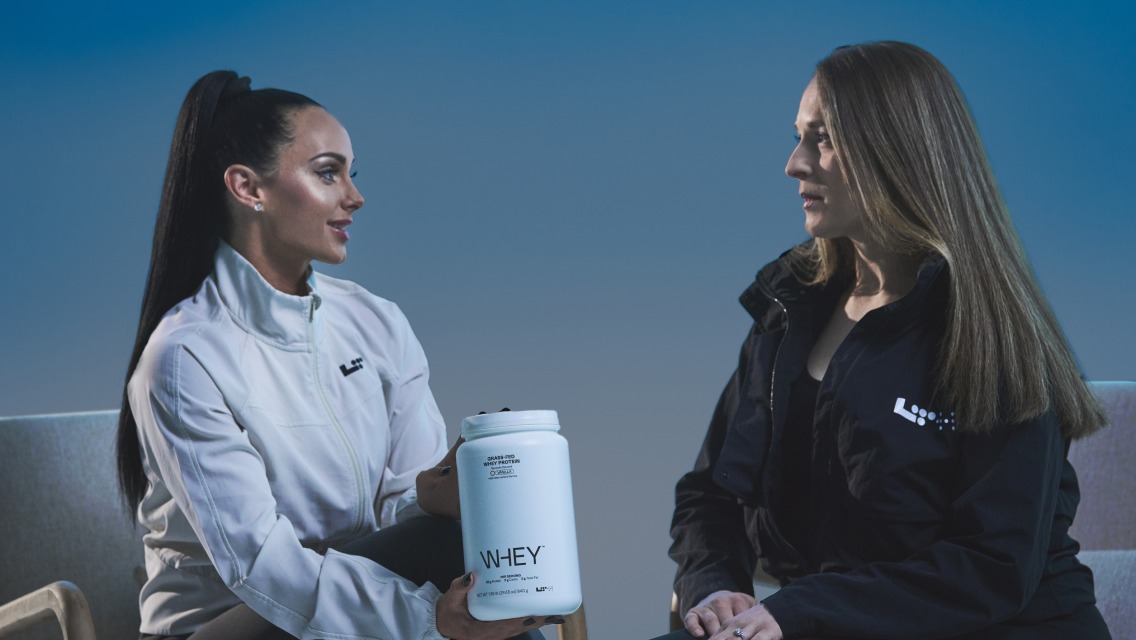
How Coach Hayley Akradi Hits Her Daily Protein Goals
The creator of The Body Blueprint strength program shares her strategies for getting enough protein to support her health and training efforts while also maintaining a nourishing, anti-inflammatory approach to eating.

Coach Hayley Akradi’s Sleep Secrets for Better Health and Performance
The trainer and creator of The Body Blueprint strength program offers her expert tips for getting the quality sleep that’s needed for sustainable progress.

What’s Really in an Effective Strength-Training Plan?
With Jeff Rosga, CPT
Learn the movement patterns and other variables that form the backbone of a well-rounded and productive strength regimen.
Listen >
Transcript: All About The Body Blueprint
Season 11, Episode 9 |
[MUSIC PLAYING]
Welcome to another episode of Life Time Talks. I’m Jamie Martin.
And I’m David Freeman.
And in today’s episode, we are introducing you to one of newest training program at Life Time. It’s one of our digital training programs. It’s called The Body Blueprint, and we’re really excited to have the creator of this program with us today to talk through why she created this program, how it’s worked for her in her own everyday life, and to be able to explain some of the other lifestyle things that she does that support it. So with that, I’ll hand it over to you, David.
So we’re joined today with Ms. Hayley Akradi. She’s a certified personal trainer. After spending 10 years training members in the club, she now serves as a national program lead for Ultra Fit, which is one of Life Time’s signature group training programs. She also works on digital fitness projects for the Life Time digital app. You’ll see some new digital training program coming from her in the app. Welcome, Hayley.
It’s good to be here.
How are you today?
I’m good. How are you guys?
Doing well. We’re excited to talk about this. This is an exciting new program to have as an offering for anybody who’s using the Life Time app. But we want to start, because this is based on how you train in your own life, tell us a little bit about you and how you came to develop your own personal fitness and lifestyle philosophy.
For sure. So I’m excited, first of all, for The Body Blueprint because I’m excited for people to go through it the way that I have. And I’ve called it the Blueprint because it’s quite literally the blueprint of how I train every single day. So as far as how I got here, I feel like it only makes sense for me to take you back to about 2010. That’s when I graduated high school. That’s really when I discovered strength training as a whole, dabbled in it.
I got my first membership at Life Time. I was taking yoga classes, strength training classes, all kinds of things. I even popped into an Alpha.
Yo.
When did that start?
2009, ’10, sort of that time.
So it was probably within its infancy.
Early days.
At St. Louis Park. And I started to really understand how I could manipulate my body with different training techniques. And I started getting really serious in that. In about 2015, ’16, I decided I was going to hire a coach, I was going to go into the bodybuilding world, and I was going to be in that sport. And then things took a little bit of a left turn. When I went to Mexico, my best friend’s wedding, I ended up getting very, very sick. I later on realized that I got salmonella from the lettuce.
Don’t eat lettuce in Mexico. Don’t have the water. We’re always told that. And it started as just an illness. I didn’t drink, but I woke up feeling like I was very sick, very hungover, I wasn’t. And then I needed to figure out how am I going to get home, how am I going to get back to the US and figure out what’s going on. Did that. I found out it was salmonella, took a Z-Pak, thought I was getting better, and then I started to have pain in my right leg.
And I was like, well, I know it’s not an injury. I haven’t worked out. I’ve been sick. I’ve been laying on the bathroom floor for 10 days. Went to the doctor, they were like, yeah, I think you just pulled your quad. Clearly, you can’t move it. And I’m like, OK, well, I don’t think that that’s what’s happened. But I went home. Things started to get really out of control. The pain started to get worse and worse.
And then this was 2016. So I don’t know if you remember, but we used to wear black slacks to work, like the stretchy bell bottom to the office all the time. I knew it was bad when I couldn’t get those over my knee anymore, so it had started to swell up to the size of this. And the pain was painful, but it hadn’t really set into its full intensity at the time. A couple of days later, it felt like there was little knives floating in my leg. Anytime I would breathe or move, there was so much pain.
I checked myself into the ER. They did a bunch of tests. They told me that I was literally perfectly fine, and that I needed to go home. I went home, I ended up getting stuck in my closet because I couldn’t move off the floor. I ended up checking myself into the ER again, getting admitted into the hospital. They thought it was a blood clot. They couldn’t figure it out. I was there for three days. I saw six different doctors. They were like, you’re good, go home.
I was like, all right. I’m on oxycodone every single day, all day. I’m on crutches. I can’t walk. Six months went by before we had any answers. So I was on crutches. I couldn’t walk for six months, completely atrophied all the muscle that I had built, which is very scary. And so I started seeing — I went to Mayo. They were like, guess what? They had all the answers. The last time you were in the hospital, nobody just looked at the results of your tests.
So it ended up being an autoimmune condition that’s caused by a gene called HLA-B27. That means nothing to anyone. But that is for reactive arthritis. So this type of arthritis reacts based off of three different infections, one of them being salmonella. I had no idea I had this autoimmune condition. So I saw a rheumatologist. They basically told me, you need to be on all these cancer medications that were going to cause a multitude of other problems. And I was like, that’s not going to happen.
So I went the holistic route. I found a holistic doctor, who I still see to this day. She’s amazing. But within two weeks, I was walking again. So we decided to take — we went the route of just getting rid of inflammation. What’s causing your body to be so upset right now? Take away the foods that are causing you issues, take some supplements, a little deeper than that. But within two weeks, I was back on the training floor again.
My knee was working. I didn’t have any muscle, but we started over. So I got back into bodybuilding, made it to the national level. That takes us to about 2018. And then I realized that the stress that I was putting on my body with the different foods, all the different things, was just causing more and more inflammation and stress and cortisol levels and everything, causing my autoimmune to be out of control.
So I started to train a certain way. I took bodybuilding out of my lifestyle, competing, still training in a way to manipulate my body but without the cortisol levels going through the roof, without having so much cardio and so much output, and training in a way that caused or that let my body calm down in between training sessions. So that’s where this came from.
So 2018 on, and even in 2018, after stopping bodybuilding, my hormones went crazy. I think that’s actually even where I met you. I was training at Life Time. All of a sudden, I’m 35 pounds heavier, and I have no idea why. My hormones and my autoimmunity, everything, I was completely out of homeostasis, and I needed to bring everything back to just calm.
So just training in a way that lets my body recover between sessions, making sure — and we’ll talk about this later, making sure that I’m eating before I’m working out, not doing fasted cardio for my body, somebody who’s stressed into that autoimmunity world. So that’s where a lot of my training programs stemmed from. And then building this program came from all the different pieces that I liked and loved from training and putting them together in a way that didn’t stress my body.
That’s a very long story, but that’s really why when we talk about the things that I do before and after training, between training, the way I train, it all comes from a very holistic sense versus an athletic approach.
I mean, when you break down, obviously, the experience that you went through to now create what is now The Body Blueprint, that’s great to give us that foundation. For those listeners and viewers that are seeing this and hearing this, what exactly would come of The Body Blueprint as far as if they’re trying to achieve certain goals? What objectives and things come from this actual program?
So the goal behind The Body Blueprint is to build strength, also build muscle while being able to burn fat.
Walk us through what a week of exercise looks like for you. What does that look like? How many days a week? How long are people working out for? Give us some examples of those workouts.
So right now, to be completely honest, it’s literally The Body Blueprint. So we’ll dive deeper into that later. But as far as what my week looks like, I have two upper body days. I have two lower body days. I have one athletic full body training day, whether that comes from the program or Ultra Fit. I love Ultra Fit as a piece of this program, too, as an option to be able to do sprint workouts, something that taps into your hormones a little bit, but also is not muscle-wasting cardio.
So I love to add that. But right now, it’s two upper body, two lower body, and then a full body day.
And you’re leaving yourself space for a couple of days of recovery from there, which I think is really key to note.
So I train on — if we want to get really specific, I train on Mondays, Wednesdays — actually, I’m going to back that up because I take Tuesdays and Fridays off. So the other days, I’m training.
Five days a week. Five days a week.
Five days a week, yeah, and then if I ever feel like I’m just totally taxed, like I said, that full body training day is completely optional. So that’s a day where I’m like, you know what? I think just with life this week, my cortisol levels are here, and I need to be here. And that’s where you just take that day off.
I’m sorry. All I was going to say is, even though you might have it slated out on certain days, let’s say those two days that you said are off, the people who are following the program, they can now mix and match their days just in case those days don’t work, or as long as they’re still getting their two up or two lower and then the one total?
Yeah. So I have in The Body Blueprint, we have actually five strength training days and then a sixth full body day. So there is a shoulders and core day. There is a quad base lower body day. There is a glute and hamstring-focused lower body day. And then we’ve got back and bi’s chest and tri’s. This is where it gets to where you can make it your own.
So if I am hitting Ultra Fit or I’m hitting that full body day, sometimes I’m getting — personally, for me, I’m getting enough chest, where sometimes that chest and tricep day doesn’t happen for me. Chest is very important when you think about counteracting your back, as you know. But as long as that’s being hit at some point in the week, that’s another day that as a female, I don’t always do. So I make sure that I get five days a week, and then I’m usually missing one of those other days.
So in the app for the Blueprint, so they have options throughout the whole week or what’s the breakdown?
Six.
So six days, and then the other day’s a recovery. And then you have cardio blend in there, too?
So that’s going to be in the full body day. So I don’t actually do cardio in my program, not because it’s not useful. It’s absolutely a tool. There are so many different ways that you can incorporate cardio into a lot of different programs. I am not somebody who can do fasted cardio because when we talk about autoimmunity, we talk about inflammation, things like that, like spiking the cortisol, especially early in the morning, is really hard for somebody like that.
But I think cardio is still a tool. It’s still important. So actually today, I am on week 5 of The Body Blueprint right now, by the way, and it was quad day. And so I am able to incorporate cardio within the program, within the lift. So on week 5, the main — and we’ll talk about this. The primary movement of the day is front squats. I’m doing six reps. I’m doing it five times through. I’m going heavy. We’ve got lots of breaks.
But then what comes right after that is a triple set of 10, 20, 30. So I’m doing 10 leg presses, 20 leg extensions, and then 30 walking lunges with dumbbells. I think I was at 156 beats per minute at that point, so still getting the cardio, then bringing it back down with just a regular superset and then at the end, doing speed squats 10 times 6 with only 10 seconds rest. So I’m still doing cardio within the program. Not every single week is as intense as that, but absolutely incorporating it in that way.
Gotcha.
When people may not expect that to be it, but I was just thinking, I was just doing walking lunges the other day with holding dumbbells, and it’s —
They’re actually the worst.
And you’re going like, oh, my gosh, are these over yet? I want these to be done, especially if you go at a decently heavy weight, and you’re going to hover or whether it’s for seconds or for reps, whatever it looks like. I was doing this with my 14-year-old daughter, who now wants to work out with me, which is really fun.
Oh, that’s fun.
She’s like, these are terrible. My legs hurt.
They are terrible.
It was like, she wasn’t expecting it.
When I did this workout today, I remembered I was like, I took my corporate team through this entire program. And I remember Jesse being like, I’m not doing that many lunges. And I was like, you need to get your cardio in today. Let’s go. And that one will beat you up a little bit. Not in a horrible way. Like what I’ve just been talking about, I’m not trying to beat myself up in these workouts. But the cardio and the intensity every now and then is really important for the body, too.
Absolutely. Talk a little bit about the recovery efforts that you do and how you want to encourage people when they’re doing your program to make sure recovery is very intentional.
So I am not working out on Tuesdays and Fridays. So I absolutely have off days where I am not working out at all. That doesn’t mean that I’m not moving. I always tell people I’m not sitting on my couch, or I’m not just sitting in the office all day. NEAT is super important, which is your non-exercise calories that you’re burning. So that’s usually a day where I’m coaching in the morning. I’m probably — well, Tuesdays, I take gymnastics — or I take Daria to gymnastics, my baby. So I’m still moving.
And then the days that I’m training harder are usually the days where I’m sitting in the office all the time, so making sure that you’re thinking about recovery, making sure you have a couple days where you’re not working out super excessively. And then I do a stretch session at Chanhassen once a week, just so I can stretch in a way that I can’t do myself. And then I love the infrared sauna for recovery, too.
This program is not just for somebody who has inflammatory issues, but I love that with my workouts because it does bring the inflammation down.
Awesome.
And sweat. I don’t do cold plunge.
No?
No.
Didn’t get you in that cold? You live in Minnesota as well.
So my joints, my joints, it’s because of that, so. Everything that we just talked about at the beginning, as soon as I put my knees in that cold plunge, I’m like, I don’t know, this is a little bit of PTSD.
It’s too much. Too much.
So, I mean, we want to know, are there certain exercise habits that are non-negotiables for you?
So one thing that I do before training is I always eat first. I never work out fasted. For me, because I’m always reaching for something called MMF, which is momentary muscle failure, which is something that we talk about in the program. I dive into that a little bit more, but being able to actually lift heavy and have the energy to do so and getting heavy enough to where you actually need a break. For me, I can do that by getting protein and carbs in the morning.
So I’m usually getting about 30 to 40 grams of protein and 40 grams of carbs. I know I’m getting exactly 40 grams of carbs before I go lift in the morning. So my morning routine is very much the same. I’ve got electrolytes right away, then I eat, then I caffeinate, then I lift. So that is number 1. Number 2 and 3, coming in with a plan and scheduling them. So I always come in with a plan.
There have been days — I’ve seen it with clients where they’re like, don’t worry, I’ll get my back and bicep day in. And they think they’re going to come in and do 45 minutes of back and biceps, and they’re just going to make up the workouts as they go. And all of a sudden, you pick up your phone and people are sending you emails, and they’re trying to schedule meetings and you’re like, you know what? I’ll just do this another day.
If you don’t have a plan, you don’t have an objective that you need to finish or that you need to get to. So I always come in with a plan, and I don’t care where that plan comes from. I care where the plan comes from, but — but there needs to be a plan, something that you’re trying to get through A to Z before you leave, and then scheduling them. And Jamie, we talked about this in a meeting earlier this week. I always schedule my workouts. So first, you’ve got the plan. Now, how are you going to execute it and when? I know that every Monday is shoulders and core. I know every Wednesday is my quad-based leg day. I put those on my calendar, and I always show up for myself.
If something crazy happens, I’ll move it. But if you don’t have them on the schedule, you’re going to wake up and say, I’m a little tired today. I’ll do that one tomorrow. And then that turns into tomorrow and then tomorrow. So scheduling them, whether that’s scheduling a class or scheduling your workout schedule and show up for yourself, that’s one of my favorites.
Love it, love it.
What about other health habits that are non-negotiable for you? What would those be?
Sleeping 80/20. So sleep, I sleep seven and a half to eight and a half hours. If I don’t get that, I feel like a crazy person. I have a baby at home. I need energy for her. I need energy for my workouts. I need to be recovered. So I know that Daria, my 20-month-old, wakes up at 5:15 every day for the day, and that’s really unfortunate for us. But that’s how —
She’s an early riser.
She’s an early riser, and I think I instilled that early on because I do coach early classes in the morning. So I’ve always gotten up early, and I think she just thinks that’s what we do. But in order to then get that many hours of sleep, I have to be getting ready to lay down and fall asleep by 8:30, 9 o’clock, which seems crazy to some people. But that 9:00 to 5:00 is where I get my eight hours of sleep. And that’s super important, again, for recovery, for results, all of that.
And then 80/20. 80/20 is something — my 80/20 is a little bit different. So 80/20, a lot of times you hear influencers talk about macros. My macro’s 80% of the time, and then I eat whatever I want 20% of the time. For me, I eat non-inflammatory foods, food that comes from the ground 80% of the time, and then 20% of the time, I can go out to eat, or I can enjoy some cookies with the baby or whatever it is.
But I don’t eat seed oils. I don’t eat really anything with added ingredients, so I try to eat as much grass-fed ground beef, organic chicken, fruits, vegetables as I can. That’s my 80. And then 20% of the time is a nice little treat. And that just helps me again with the recovery. But also when we talked about my story at the beginning, it starts to spark autoimmune conditions as soon as I start to bring in fake food.
How often is that happening for you now, especially since you’ve been being more consistent with this over the years?
So when COVID happened and then the restaurant started opening back up, I had sushi that got a little weird, and it was like a mild food poisoning case, sort of. And then it happened again. And Freddie, my husband, took me into the hospital. We drained it, gave me a cortisol cortisone shot. And that was that, thankfully. However, I do still have joint pain every now and then, and I notice that when I’m eating canola oils or seed oils or something like that.
Something that’s super inflammatory, I can just tell. When I go and work out, everything feels 50 pounds heavier. So that’s important for me, not only for a results-driven plan like fat loss, muscle gain, all of that. That’s important just to eat at home a lot, prep your meals, but also for an inflammatory standpoint.
Got it.
We got so many different training programs out there. How would you recommend to individuals who are looking for the right training program? We got like The Body Blueprint. And you have so many other things that you probably have seen during your tenure as far as being in the health and fitness industry. How would you go about recommending what’s best for these individuals? You got a fat loss over here. You got muscle build over here. Help us navigate that.
So that one, whatever you can be successful and sustainable with. So what I mean by that is if you know that you have three days to work out and you choose a six-day-a-week program, you’re probably not going to be successful, and you’re probably not going to sustain it. So you can absolutely get there. If you’re like, I really want to work out six days a week, you can figure that out at some point, but you need to first feel like you’re successful at something.
So if it’s a three-day-a-week body fat-loss program or something like that, and that fits into your schedule and you feel like you can be successful with that, absolutely. For something like this, The Body Blueprint program is something where you do have to put a little bit more time into it, but you are absolutely going to see body composition change. So I think as long as you can sustain it and you feel successful at it, then it’s the right program for you.
I think it’s really important when we talk about the personas that we come out with, like, The Body Blueprint is my program. I’m literally in week 5 of it. I’m actually doing it. I think it can be frustrating for people when they go on to Instagram and they find somebody — females, especially, I’m sure men do this, too. I have no idea. And they see somebody and they say, I would do anything to look like that, anything,
I want to know how she does what she does. I want to train like her, and I want to look like that. And then they go to their link in their bio, and they buy a three-day body booty building program. That has been created to put money in their pocket, to put food on their table, and it’s not actually something that they do. So I think it’s really important to call out that The Body Blueprint and all of the programs that we’re coming out with under specific people that this is actually how we live our lifestyles.
This is actually how I train. I don’t sell you programs that are going to be fat loss in three weeks or build your shelf booty for this or whatever it is. This is quite literally how I train to live my actual life. And I think that is very important. Important.
It goes back to, I think, so much of what we’ve often talked about at Life Time. It’s like — and we say that part of the motto for experience life in particular is like no gimmicks, no hype. We’re not going to tell you something that is unrealistic or unsustainable. We want to empower you with information. We want to give you tools to do things. But it’s not about the quick fix. We want to actually help you make change that is sustainable for the long term, whatever that looks like for you.
It takes a lot of programs. This program might not be for everybody, and that’s OK. But this is how I train to get the results that I have. So if that resonates with this person, then this is actually it. It’s not just a three-day program that I thought would be fun to write for somebody to try.
You’re living it. You’re doing it on a day-to-day basis.
And I love that you said it. If it’s not the right fit, we have so many different other options within our digital program that they can gravitate towards. And it is vetted out, and it is result-based driven. So that is the dope part about all the different options that we have underneath the digital app.
Exactly.
What element does enjoyment have? I mean, we often hear about do the kind of movement exercise that you enjoy, too. And I know we still want things to be hard. We still want it to challenge us. But I do think there is something to that whole enjoyment. And you must enjoy moving your body in this way to keep doing it over and over. I find that with strength training for myself, too.
So I actually — I know that a lot of programs — there’s nothing wrong with this. It’s very results-driven. But a lot of programs, whether they’re four weeks or six, eight, 12 weeks, they usually go in phases. And within those phases, whatever they are, usually, the workouts are, especially in bodybuilding, are the same every single week. You know that that back day is exactly that way for however much time that the coach tells you to do it for.
That monotony makes me super bored. So I have taken a lot of different exercises that I love, and then within this program, we progress through different workouts, and we’ll talk about that more exactly how it’s designed. But while the objective is exactly the same for each day of the week, the exercises slightly change. So you might have a different type of a row that you do.
You have an overhead pull down. There’s different variations. The reps and sets change a little bit. The pauses, the eccentrics, all of those change a little bit to keep you thinking and a little less bored.
Got it.
So strength training can get boring sometimes. You know that getting strong at the basics. You’re like, I’m doing squats again. That’s great. But what can we change within the rest of the workout to make it a little bit more fun?
I don’t want you to keep you coming back because — that’s the thing. It’s like, even if — especially if you’re not often with digital programs, we find that there can be fall off because you’re not working with an actual coach. That’s the beauty of being able to go in. So how do you stay engaged and get excited to go back time and time again?
Well, that was the biggest thing, I think, with working with one of my bodybuilding coaches, who was amazing, but I knew that I hated the leg day that he had for me. But I had to do it for eight weeks. And so every day, it felt like every leg day that that day would fall on, I’d wake up and I’d be like, I think I’m tired. I think I’m sick. I think I’m this. All the things of like, I didn’t want to go and do that day.
So if you have a day that you didn’t necessarily love this week, it’s going to change a little bit next week. The goal is the same, the objectives are the same, but it’ll feel a little bit different. And that makes it a little bit more exciting to go into a new week of workouts.
Awesome.
I mean, I love what you said there. And I think it’s the beauty of programming and to the point of you still have linear, progressive programming within both The Body Blueprint or with some of our signature programs that we have, and that element of having an individual help bring awareness to why you’re doing that. I mean, I go back all the time when you look at people within their disciplines of certain sports, and they go to practice and it’s like, they’re doing the same thing over and over.
It’s important.
So it is super important. But to create a little bit of the variance, whether that is slightly changing certain acute variables, maybe it’s the rep scheme, maybe it’s the load, maybe it’s the tempo, those things change. Granted, if it is the same movement, you’re still seeing the back squat, or you’re still seeing the leg press. So now if you have the education behind it to connect to that person and be like, this is why you’re doing that, it’s a little bit different coming through the app.
Well, now when you have that variance, which is great, because now week over week, you’re seeing something a little bit different to keep you engaged. So that’s a great game-changer there. So when you break that down now, how did you choose the structure breakout of your programming here?
So The Body Blueprint is a mix of strength and hypertrophy. Like what we just talked about, it’s not actually phases. We don’t have four weeks of strength and then four weeks of this and then four weeks of this. This one combines the two. And I’ll tell you how throughout the eight weeks. So for your primary movements, we talked about that every single day has a primary movement.
On your shoulders and core day, you have an Overhead Press that stays, that primary movement, throughout the eight weeks. What we do with that for progressive overload and working from hypertrophy to strength is we start with 10 reps times 3 sets. That’s for two weeks. The next two weeks, you’ve got 8 reps times 4 sets. And then it’s 6 times 5, and then 4 times 6. So there’s volume there that’s changing. The repetitions are about the same when you do the math.
But how you’re breaking them up is different. So we’re moving into strength. So you’re starting to get stronger. 10 by 3. You’re not doing the same weights as the end where you have four reps six times. You should be able to go a lot heavier at that point. And then within each of those days, each week, there are other accessory movements that we do and that some of them have higher reps. We start to introduce supersets, triple sets to get some of that cardio in there.
And then we also do other variables, like eccentrics, iso holds, things like that, to just wake your muscles up, change your brain a little bit, too. And those workouts change throughout the eight weeks. So also, I know a lot of people are like, well, what is hypertrophy? I know that was one question that came up a few different times. So you have strength, which is going to help you get stronger. You have hypertrophy, which is going to help you build muscle.
The strength reps are much shorter. So you’re thinking three to eight-ish reps, and then hypertrophy being that 8 to 12, sometimes even 8 to 20, depending on what you’re doing. So you’re getting a mix of that. You’re getting some of those short reps go heavy. You’re getting some of those higher reps to build muscle. We want to build muscle, so that way, we can burn fat efficiently. But we also want to get stronger.
And I hear so many women in particular say that I don’t want to lift too heavy because I want to get bulky. But when you think about what strength is doing is, it’s squeezing that muscle super tight, which actually makes you look leaner. So if you can build muscle, tighten up, and burn fat at the same time, that’s how you’re going to get to that change in your body.
Well, and that’s — I mean, that was the next question is, why did you build it, the program this way. You just totally addressed that. So it’s really about helping people see that body composition change. If it’s something that they’ve maybe been struggling with, this is probably a kickstart for them, I mean —
Absolutely. And it’s not a fat loss program — oh, I won’t say that. It’s not a weight-loss program because I notice, even in myself, after eight weeks, my weight might come down a little bit, but it’s really my muscle coming up and my body fat coming down. I look completely different. I feel different in my body. And I love this program, too, because as soon as you’re done with week 8, you can come back to week 1 because like we talked about, the workouts aren’t the same every week.
So it’s not like you’re starting back at week 1 and you feel like you’re doing the same workouts for eight weeks. You’re starting back at that 10 reps times 3 and hopefully being a lot stronger because you just finished lifting 4 reps times 6. So you can continue to do this to continue getting stronger. And I think I’ve done this in a row. I think I’m on round 4 right now. I’ve done it more than that because I was doing this pre-baby as well. But I just keep going and getting stronger, so.
So what fitness level would you say, would it just be beginner, intermediate, advanced, all of the above?
I would say intermediate and above because of the progressive overload and getting to those really heavy sets, I think it’s really important to have a foundation of how to move. Especially in the squats and the hinges and the overhead presses and things like that, you need to have an understanding of what weightlifting is. To the beginners, though, that want to get into this, I do coach you through it.
I have a lot of videos talking about what we’re going to do. I have coach’s notes to help explain what it should look like. So it’s obtainable for a beginner. But I would say, for that experience-lifter, this is a good place to be.
Nice.
Well, and I just want to clarify what you mean by experience-lifter because, I mean, there’s different phases of that. Like for instance, like I’ve been lifting weights for 25 years, but I have never done like bodybuilding. So you don’t have to be somebody who’s done bodybuilding, but you have that, again, to that point, that base, that foundation, you know what a strong squat looks like.
I need to know that you can put weight on your back and still be able to move properly because as you’re progressing that load, especially in the last couple of weeks, if you’re lifting weight that you’re only going have four reps for, if you can’t really move, you’re not going to get a lot out of that. So just knowing how to move properly in some of those movements is important before starting the program.
Makes sense.
And I know you said it in the beginning, when you were going through your journey to help navigate you to getting to your best health that you could be, you had a holistic approach to putting together this program. So can you walk us through what that holistic approach is?
Absolutely. So we did talk about having those rest days. That helps you recover, but I also split this up. It is very much like a bodybuilding split. It feels that way. But I do that because when I do, let’s just say a shoulders and core workout, I need seven days before I hit shoulders again to really feel like my inflammation isn’t out of control. So splitting it up this way really helps you actually get recovery for that next time that you hit that day.
But also bone density health, resilience to disease, age and longevity, I think that’s something that’s super hot on the fitness trend right now is women especially are making sure that they are strength training so that they don’t have bones like chalk when they’re older. We need them to be protected and healthy. And when we have healthy bones, we have less disease. So strength training right now is really just like the armor for being healthy when we get a little bit older.
I love that approach because we actually had in the most recent season of the podcast, last season, we had a big episode on bone health. And it doesn’t matter how old you are, bone health is something we need to be thinking about regardless of our age. And strength training is so fundamental for just building that and making them strong.
And I just listened to a podcast, actually, then they were talking about how so many times people are like, they see the people on the treadmill running 10 miles a day and they’re like, I want to look like that, but there’s no muscle there. So then when you start to age, you actually start to get sick. You’re a little breakable. And we don’t want to be breakable when we’re older. So just making sure that you have enough muscle on your body to protect you.
Awesome. So as you think about this program rolling out and people trying this program, what are you most excited about, as you think about more people discovering this approach?
First, I was excited about accessibility. I think it’s really cool that it’s going to be available to the people who are currently our members, who are not. Literally anyone can access this, but I’m really excited for people to try and discover a different way of strength training that’s going to help them get to where they want to be, as far as body composition, without completely overtraining and feeling overstimulated.
And I think so much of our world right now is over cortisol. We wake up and we rush into everything that we’re doing. So just making sure that your workouts help you for life versus put you over the edge, that’s one of my favorite things about this program.
All right. We did a lot with The Body Blueprint. Before I get into the mic drop moment, is there anything that we might have missed that you want to make sure our listeners and viewers can be in the know of?
I think we covered it, but I’m always worried about your mic drop moment.
Oh, it’s nothing — nothing to be worried about. So I make it pretty simple since we’re talking about programming and all. If you only could have one lift for the rest of your life, there’s only one you could do —
I know what it is.
What exercise and what lift would it be?
So my favorite day, first of all, is my shoulders and core day. My shoulders are so strong, I’ve atrophied my legs so many times that these babies are weak, but — seated barbell overhead press.
Really?
Yes.
That’s the one —
That’s the one you would do for the rest of your life?
We’re just like, what?
I knew she was going to say leg rest, squats, or something.
No, no, because now I’ve got to do plate math really quick because — no, because I can do 95 pounds overhead. And I feel like that’s really strong.
Yeah, it is. I’m just saying this is the —
That’s a 25-pound —
Yes, for the rest of your life. Yes. Shoulders? Yes, or maybe some lateral raises because those make you look —
That’s shoulders.
It’s still shoulders.
Still shoulders.
It’s always shoulders. If I didn’t have my jacket on right now, you can tell my shoulders are probably the biggest part of my body.
What about you? I’m curious now. What would you pick?
Oh, my gosh, mine’s so boring.
I’m glad I shocked you a little bit.
I am more like, I love the squat.
The squat.
I love squatting, and I love that there’s so many different ways to squat. I can squat with my heels, or I can do goblet squats. You know what I mean. If I could do — as long as I could do variations of the squat, I’d be happy. But I like the squat as a full body movement.
I love it. I’m a squat, too. I’m going to say the squat.
Look at us being boring. Yours was exciting. So people can find this program. They will be available in the Life Time app. The Life Time app is free, complimentary for anybody, anywhere to download, which is really exciting. And if you want to stay connected with Hayley, you can follow her on Instagram @hayleyakradi. It’s H-A-Y-L-E-Y-A-K-R-A-D-I —
That’s me.
—on Instagram.
That’s a lot of letters.
That’s a lot of letters getting in there, but follow Hayley and can I just — what I love about what you’re doing on your social media as well is you shared just your day-to-day life, too, and the different ways, like you bulk food prep, you do all these things, which is really fun to see. And we’re going to be covering more of that, too.
And you get to see how I feed my baby, all the things. So we go deep there.
That’s awesome. Well, thank you for joining us. Thanks for telling us about your program.
Thank you for having me.
Appreciate you coming through.
[MUSIC PLAYING]
We’d Love to Hear From You
Have thoughts you’d like to share or topic ideas for future episodes? Email us at lttalks@lt.life.
The information in this podcast is intended to provide broad understanding and knowledge of healthcare topics. This information is for educational purposes only and should not be considered complete and should not be used in place of advice from your physician or healthcare provider. We recommend you consult your physician or healthcare professional before beginning or altering your personal exercise, diet or supplementation program.