


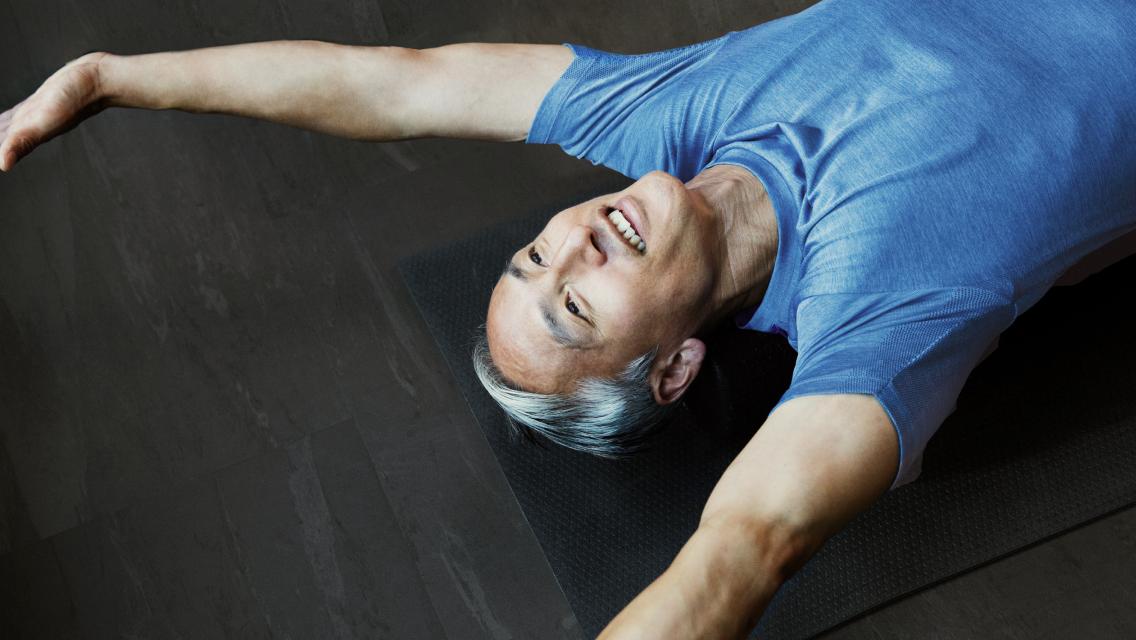
Aging well includes your ability to move with confidence, maintain independence, and avoid injuries and pain. At the center of your body’s ability to do all these things, quite literally, is your core.
“Your core is so much more than just ‘abs,’” says Kelly Hegarty, CPT, Dynamic Personal Trainer at Life Time in St. Paul, Minn., with more than 20 years of experience. “The core forms the foundation for nearly every movement we make, and encompasses the muscles of the spine, pelvis, hip joints, and abdomen. These muscles work together to stabilize the trunk, maintain posture, and transfer force between the upper and lower body during just about any movement.
“As we age, core strength becomes even more important as weakness in these muscles can lead to poor posture, back pain, difficulty moving, and increased fall risk,” she adds. “A strong core helps keep the body upright, resilient, and functional. Most importantly, a strong, stable core allows you to safely enjoy the activities you love — like gardening, traveling, or playing with grandchildren — while reducing the fear of falls or injuries.”
To help you keep this entire muscle group strong, Hegarty created the following core-training workout that you can add to your exercise rotation.
“Older adults can benefit from two to four sessions per week of focused core training, in addition to general exercise like walking and strength training,” she says. “These sessions can be short and integrated into your regular workouts — just 10 minutes of targeted core work can make a huge difference.”
1. Glute Bridge
“Although this move primarily focuses on the glutes, strengthening these muscles supports pelvic alignment while also engaging your lower back and abdominals to stabilize your trunk,” Hegarty explains.
- Lie on your back with your knees bent and feet hip width apart on the floor.
- Press through your heels to lift your hips until your shoulders, hips, and knees form a straight line.
- Squeeze your glutes as you lift, then lower slowly.
- Throughout the movement, draw your belly button in and keep your spine in a neutral position (don’t arch to achieve a higher bridge).
- Repeat for 12 to 20 reps.
Note: To progress, hold a dumbbell or kettlebell at the hip with your hands or try a single-leg variation.
2. Bird-Dog
“This exercise is great for cross-body stability — it builds strength in the lower back while engaging your abs and glutes,” says Hegarty. “It also allows you to work on balance and body control in a safe, low-impact position.”
- Start on all fours in a quadruped position with your hands under your shoulders and knees under your hips.
- Extend one arm forward as you send the opposite leg back (for example, bring your right arm forward and left leg back). Keep your hips level and core tight as you avoid arching your back.
- Hold briefly, then switch sides (bring your left arm forward as you bring your right leg back) while keeping your spine neutral and moving your pelvis as little as possible.
- Repeat for 8 to 12 reps on each side.
3. Incline Plank
“This exercise helps build deep abdominal strength while also engaging your shoulders, glutes, and back for full-body stability,” says Hegarty. “Plus, it supports spinal alignment and posture.”
- Stand and face a knee-height bench, box, or chair.
- Place your hands on the edge of the surface, about shoulder width apart. Keeping your shoulders directly over your wrists and arms straight, walk your feet back until you form a straight line from your head to your shoulders, hips, knees, and ankles.
- Keep your lower back flat, engage your core, and pull your shoulders away from your ears.
- Hold this position for one set of 20 seconds to one minute, making sure not to pike or sink your hips.
Note: As you get stronger, you can slowly lower the inclined surface until you reach the floor to do a traditional plank with proper form.
4. Side Plank
“This move targets the obliques, which stabilize the spine and hips and are often neglected in traditional core work,” Hegarty says. “Strengthening these muscles helps build a solid foundation for daily activities like bending, twisting, and carrying.”
- Lie on one side with your forearm on the floor directly under your shoulder and feet stacked on top of each other.
- Keep your bottom knee down as you lift your hips off the floor so your body forms a straight line.
- Hold for one set of 20 seconds to one minute, keeping your core tight, belly button drawn in, and hips lifted.
Note: To make this more challenging, lift your bottom knee off the ground and hold both legs in a straight line. To make it even more challenging, raise your top foot three inches as you hold your plank.
5. Pallof Press
“The Palloff press is a powerful anti-rotation exercise, meaning it teaches the core to resist twisting and builds functional stability for everyday carrying, pushing, lifting,” Hegarty says.
- Anchor a resistance band (or a D handle if using a cable machine) at shoulder height and stand with your left shoulder pointed toward the anchor point and feet at least shoulder width apart.
- Grasp the band with both hands at chest level and step far enough from the anchor point to create light tension on the band.
- Brace your core and then press the band straight away from your chest until your arms are fully extended. With control, return the band to your chest.
- Repeat for 12 to 20 reps.
- Turn your body so your right side is facing the anchor point and repeat for 12 to 20 reps.
6. Dead Bug
“This exercise strengthens the transversus abdominis and engages and builds endurance in your deep spinal stabilizer muscles,” says Hegarty. “It’s great for motor control and overall coordination.”
- Lie on your back and extend your arms and legs into the air: Your arms will be straight over your chest; your knees will be bent at about 90 degrees.
- Keep your head on the floor with your neck in a neutral position.
- Engage your core, drawing your ribs down and pressing your lower back into the floor. Extend one leg to straighten it while dropping the opposite-side arm overhead. Reverse and repeat on the opposite side.
- Actively flex your feet throughout the movement. Do not lower your heels all the way to the floor. Extend and lower your legs only as far as possible without arching your lower back.
- Alternate sides, drawing your knee in only to hip level, not all the way to your chest.
- Repeat for 8 to 12 reps on each side.
Note: To make this more challenging, start with your knees a few inches farther from your chest. To make it less challenging, bring your knees closer to your chest and/or reduce the range of motion of your arms and legs.